Masai Mara National Reserve & Conservancies
Masai Mara National Reserve, The Masai Mara is not only one of Kenya’s most iconic wildlife reserves, it’s also a unique model of community-led conservation. Unlike other national parks managed by government agencies, the Mara is stewarded by local Maasai communities, blending traditional land use with modern conservation in one of Africa’s most remarkable landscapes.
Situated along Kenya’s southwestern border with Tanzania, the Masai Mara merges seamlessly with Tanzania’s Serengeti National Park, forming an enormous cross-border ecosystem — arguably the most dramatic and wildlife-rich wilderness area in Africa.
One of the most extraordinary aspects of the Masai Mara is the absence of fences — both at the border with Tanzania and between the national reserve and its surrounding private conservancies. This uninterrupted landscape allows for the free movement of wildlife, especially vital for the Great Migration, when millions of wildebeest, zebras, and other herbivores travel from the Serengeti into the Mara in search of greener pastures.
This natural freedom of movement also benefits predators such as lions, leopards, and cheetahs, as well as elephants, giraffes, and countless other species, continuing a centuries-old rhythm of survival.
The surrounding conservancies offer a more exclusive and immersive safari experience with low-impact tourism models, night game drives, walking safaris, and cultural encounters, all while supporting the livelihoods of the Maasai landowners.
The Masai Mara is not just a safari destination — it’s a living, breathing ecosystem, shaped by wildlife, people, and timeless migration routes.
The Mara River – Lifeline of the Great Migration
Originating in the Napuiyapi Swamp in the Kenyan highlands, the Mara River begins its journey as two tributaries — the Amala and the Nyangores Rivers. These merge to form the mighty Mara, which flows through some of Africa’s most iconic wilderness areas, including the Masai Mara in Kenya and the Serengeti in Tanzania, before finally emptying into Lake Victoria.
Along its route, the Mara River sustains both people and wildlife, serving as a lifeline in an otherwise seasonal ecosystem. It is  the primary source of water in the Masai Mara National Reserve, supporting a rich diversity of species — from elephants and hippos to birds and predators — all year round.
But it is from late July to October that the river becomes the stage for one of the most dramatic natural spectacles on Earth — the Great Wildebeest Migration. During this period, over a million wildebeest, accompanied by zebras and gazelles, cross the Mara River in a high-stakes journey driven by ancient instincts and the search for greener pastures.
The river crossings are tense, unpredictable, and often perilous. Massive Nile crocodiles, which lie in wait for most of the year, spring into action as the herds plunge into the waters. Chaos erupts as thousands of hooves churn the river in a desperate push for survival.
No one can say with certainty where the wildebeest will choose to cross — they often gather at the river’s edge for hours, appearing ready, only to turn back. They typically select calmer sections of the river, which can be deceptively treacherous due to lurking crocodiles and steep banks.
The Mara River crossings are not just a highlight of any safari — they are a raw and unforgettable display of life, death, and nature’s fierce determination.
Highlights and Attractions – Masai Mara National Reserve
- The Great Wildebeest Migration
Witness one of the most spectacular wildlife events on Earth, as over 5 million wildebeest, accompanied by zebras and gazelles, thunder across the plains from Tanzania’s Serengeti into the Masai Mara between July and October, culminating in the dramatic Mara River crossings. - The Big Five
The Masai Mara is one of the best places in Africa to see the Big Five: lion, elephant, leopard, buffalo, and rhino. The reserve boasts one of the highest densities of lions on the continent, making predator sightings especially rewarding. - Abundant Wildlife Year-Round
Even outside the migration season, the Mara offers exceptional game viewing. Resident wildlife includes giraffes, cheetahs, hyenas, hippos, crocodiles, antelope species, and hundreds of bird species. - Mara River
The Mara River is the reserve’s main water source and a focal point during the migration. It’s also home to hippos and enormous crocodiles, and a key habitat supporting wildlife throughout the year. - Scenic Landscapes
Rolling savannahs, acacia-dotted plains, and dramatic escarpments create classic African safari scenery, ideal for photography and peaceful game drives. - Cultural Experiences
Visit local Maasai villages for a firsthand look at the traditions, crafts, and lifestyles of one of Africa’s most iconic communities. Many conservancies offer authentic, respectful cultural encounters. - Balloon Safaris
Experience the Mara from above with a hot air balloon safari at sunrise — a magical way to spot wildlife and admire the vastness of the landscape from the sky. - Private Conservancies
Surrounding the main reserve are community-owned conservancies offering exclusive safari experiences with fewer vehicles, night game drives, guided bush walks, and a strong focus on conservation and local benefits.
Getting There – Masai Mara National Reserve
Reaching the Masai Mara is relatively easy, with options to suit every travel style — whether by air or road.
By Air: Fast & Convenient
- Daily scheduled flights operate from Nairobi’s Wilson Airport to several airstrips within the Masai Mara, including Keekorok, Ol Kiombo, Musiara, Serena, and Ngerende.
- The flight takes approximately 45 minutes to 1 hour.
- Charter flights are also available from other locations within Kenya or neighboring countries.
- On arrival, guests are typically met by their lodge or camp for a short game drive transfer to their accommodation.
By Road: Scenic & Flexible
 The Masai Mara is about 225 km (140 miles) from Nairobi.
- Travel time by road is roughly 5–6 hours, depending on road conditions and your entry gate.
- The most commonly used route is via Nairobi–Narok–Sekenani Gate, though other gates such as Talek, Oloolaimutia, and Musiara may be used depending on your location or lodge.
4×4 Vehicles Recommended
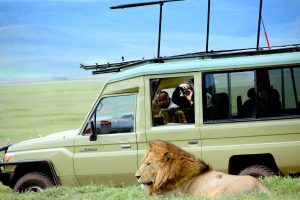
- Due to uneven and occasionally rough terrain, particularly during the rainy season, 4×4 vehicles are strongly recommended for road travel into and within the reserve.
Park Entry Gates
- Main entry points include: Sekenani, Talek, Musiara, Sand River, Oloolaimutia, and Ololoolo Gates.
- Confirm with your lodge which gate is closest to avoid long drives within the park.